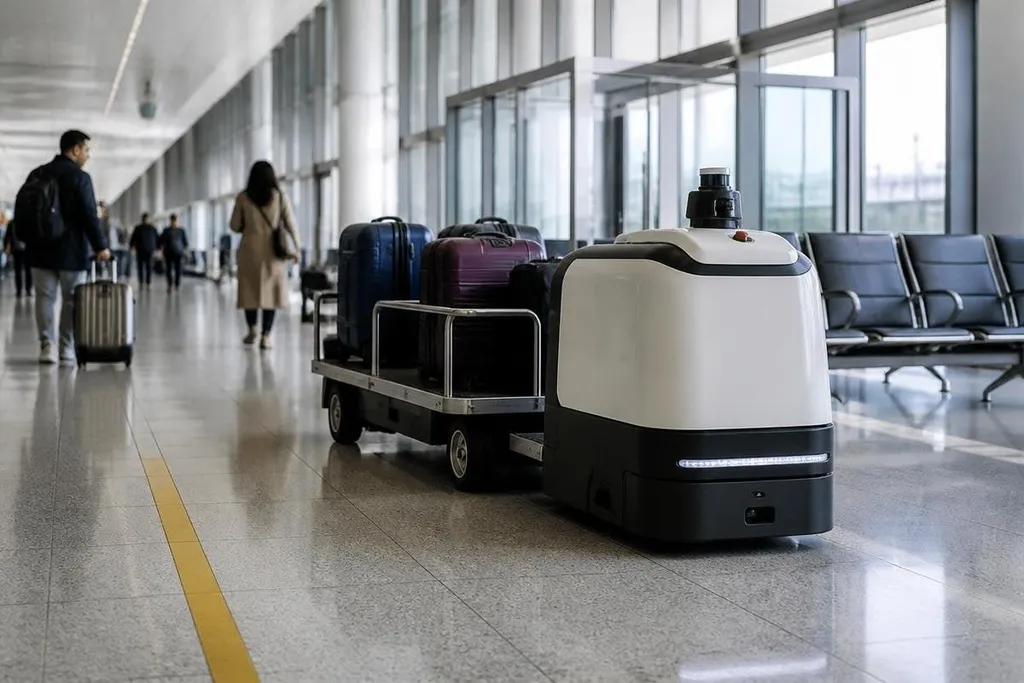
An airport robot may spend its shift moving bags, guiding people, checking floors, or carrying supplies between buildings. Those jobs look separate, but they share one problem: staff time is often needed where a machine cannot safely work alone.
This is why airport robots matter more as terminals add more services, sensors, and rules without gaining unlimited space or staff.
Quick read
- Robots fit best in repeatable jobs with clear routes and defined handoffs.
- LiDAR, cameras, barcode readers, and wireless links let a robot work around people and airport equipment.
- Human staff still need to handle exceptions, safety calls, and tasks that change from one minute to the next.
The work is repetitive, but the setting is not
Airports contain many tasks that repeat through the day. A robot can follow a mapped route, carry a fixed load, scan a code, or check an area on a set schedule.
The setting makes those jobs harder than they would be in a closed warehouse. Passengers stop without warning. Bags and carts block routes. Doors open, lifts move, and staff may need a clear path at short notice.
That makes airport robotics a problem of safe movement, not only transport. A useful robot must sense people and objects, slow down near them, and ask for help when its map no longer matches the floor.
Robots can keep staff on harder tasks
A machine can take care of a repeated trip while a person handles the work around it. That may mean helping a passenger with reduced mobility, fixing a baggage fault, checking a security concern, or making a decision during an irregular operation.
The gain comes from task division. The robot handles the route and the load; the staff member handles judgment, communication, and exceptions. If the handoff fails, the robot has added work instead of removing it.
That handoff needs clear signals. A screen, light, sound, or mobile alert must tell staff what the robot is carrying, where it is going, and what stopped it. A machine that pauses without a useful message will keep people guessing.
The useful hardware is often simple
Airport robots don't need a human shape to help. A wheeled platform with a cargo box may fit a service route better than a two-legged machine. A camera robot may suit floor checks, while a guided cart may suit a fixed supply run.
The important parts depend on the job. LiDAR measures nearby surfaces with light pulses. Cameras read signs and spot objects. Barcode readers connect a bag or package to a task. Wireless links let staff see status and send a new instruction.
Each part adds a limit. Cameras can struggle with glare.
LiDAR can lose a clean map in a busy crowd. Wireless coverage can vary inside large buildings. Airport operators need a plan for each failure, not a promise that the system will handle everything by itself.
Airport operators can use Robot24.com airport robotics reporting to compare named machines, trial sites, dates, and results before they price a system for a terminal. That evidence sets up the next check: what still needs proof when passenger traffic changes and staff have to step in.
What still needs proof
A demonstration in an empty terminal says little about a full passenger area. The real test starts when routes change, a trolley blocks a doorway, or a person reaches toward a moving robot.
Operators also need answers about battery charging, cleaning, repairs, software updates, and access control. A robot that works for a short trial may still cost too much staff time during daily use.
Safety rules matter as much as movement. The robot needs a physical stop, a clear way to report faults, and a process for removing it from a busy route. Its logs must show what it sensed and why it stopped when a team reviews an incident.
I'd back airport robots first in controlled service jobs, where the route, load, and handoff can be checked each day.
A buying checklist for airport operators
Before a trial, check these points:
- Name the task: Set one job with a clear start, finish, load, and handoff.
- Map the route: List doors, lifts, ramps, passenger queues, and places where carts may block travel.
- Set the human role: Decide who receives alerts, clears faults, and takes control.
- Test bad conditions: Run the robot near glare, crowds, blocked paths, and lost wireless coverage.
- Count the work: Record trips, stops, staff interventions, charging time, and repair time.
- Define the exit: Set the result that ends the trial, pauses it, or sends the robot back for changes.
That process keeps the focus on work the airport must get done, rather than on the shape of the robot. The next useful airport robot will be the one that can show its route, its limits, and the human decision waiting at each handoff.